GET 50% OFF WITH CODE SECRET50 - ENDS


WHY UNDERARM RAZOR BURN WON'T STOP — A DERMATOLOGIST'S INVESTIGATION

★★★★★ 3,896 Reviews | 50,000+ Women

A patient came to my clinic after years of trying to manage the same two problems: razor bumps that kept coming back, and underarm darkening that kept getting worse.

She had tried multiple razors, switched deodorant brands, and used brightening treatments marketed specifically for underarms.

Nothing had changed.

When I reviewed what she had been doing, the problem was clear. It was not her skin. It was not her deodorant. It was the removal method she had been using on one of the most anatomically vulnerable areas of the body — repeatedly, every few days, for over a decade.

Underarm skin has a significantly weaker protective barrier than skin on the legs or arms, which means it cannot recover between shaving sessions the way skin elsewhere can.

The micro-trauma from each pass of the blade accumulates rather than resolves.

The darkening she had attributed to her deodorant was post-inflammatory hyperpigmentation — melanin her body produced in response to mechanical injury that never had a chance to stop.

If that pattern sounds familiar, the diagnosis is the same.

It's not your fault.

You've been using the wrong removal method on the most vulnerable skin on your body.

✓ The underarm isn't built like other skin—its weaker barrier and multidirectional hair growth make razors uniquely damaging here

✓ Standard shaving fixes don't address the structural cause—they manage symptoms while the damage cycle continues

✓ The darkness most women blame on deodorant is actually caused by something else entirely


1. SHAVING AGAINST THE GRAIN

1. SHAVING AGAINST THE GRAIN

Underarm hair grows in three or four directions depending on the zone, which means every razor pass — regardless of angle — cuts against the grain for at least some of your follicles. This is structural, not a technique problem.

Each pass leaves a sharp beveled tip on every hair it cuts. In the underarm, where follicles curve and the skin is already reactive, that tip tries to grow back through the surrounding tissue rather than outward. The result is razor bumps — and it happens regardless of how carefully you shave.

Rosie H. VERIFIED BUYER
2. USING FACE RAZORS ON THE BODY

2. USING FACE RAZORS ON THE BODY

Face razors are engineered for thick, dense beard hair on relatively flat skin — a completely different surface than the concave underarm, where hair is finer and the skin barrier is already more permeable. The blade geometry and pressure distribution were never designed for this surface.

Using a face razor or men's razor on the underarm is a tool mismatch — the instrument was engineered for a different surface entirely, and the underarm absorbs the consequence of that every time.

Rosie H. VERIFIED BUYER
3. SKIPPING MOISTURIZER AFTER SHAVING

3. SKIPPING MOISTURIZER AFTER SHAVING

Underarm skin has a weaker protective barrier than the skin on your legs or arms, which means it recovers more slowly from the trauma of each shave. When you skip moisturizer after shaving, you leave that barrier exposed — the inflammation window stays open longer than it would on skin with stronger natural protection.

Extended inflammation is not a cosmetic issue. It means your skin keeps releasing the signals that drive pigmentation — the same cytokine response that, over repeated sessions, accumulates into the darkening you can see. Moisturizing after shaving slows that process, but it does not stop the blade from causing the trauma that starts it.

Rosie H. VERIFIED BUYER
4. SHAVING WITH HOT WATER

4. SHAVING WITH HOT WATER

Hot water softens hair, which makes it feel like the right preparation for a close shave. What it also does is disrupt the stratum corneum — the skin's outer protective layer — before the blade ever makes contact.

For underarms, which already have reduced barrier protection, this means the razor is meeting skin that has been compromised before a single pass begins.

Hot water doubles moisture loss from the skin and raises its pH. Every pass of the blade across that already-weakened surface causes more mechanical damage than it would on protected skin.

Rosie H. VERIFIED BUYER
5. BLAMING THE DARKNESS ON DEODORANT

5. BLAMING THE DARKNESS ON DEODORANT

The darkening most women attribute to their deodorant is post-inflammatory hyperpigmentation — PIH — and its actual cause is the removal method, not the product applied afterward.

Every time a razor passes over the underarm, it creates microscopic trauma at the skin surface. The skin responds with an inflammatory cascade: cytokines signal the melanocytes to produce more pigment, and that excess melanin accumulates in the tissue over time.

A single session does not produce visible darkening. But the underarm is shaved week after week, often for years — and in skin that already struggles to recover between sessions, that inflammatory response never fully resolves.

The darkness that builds is the body's record of a trauma signal that was never interrupted.

Rosie H. VERIFIED BUYER

WHAT YOUR UNDERARM ACTUALLY NEEDS

WHAT YOUR UNDERARM ACTUALLY NEEDS

The underarm has a weaker skin barrier than almost anywhere else on the body, hair that grows in multiple directions, higher sweat and apocrine gland density, and a concave geometry a flat blade cannot navigate evenly. Razors work against all of these realities at once.

Bare Basics No-Shave Hair Removal Cream removes hair chemically rather than mechanically. Calcium thioglycolate breaks the disulfide bonds in the hair shaft below the skin's surface, dissolving the hair without blade contact — so regrowth emerges without the sharp transverse tip that re-enters the follicle and restarts the inflammation cycle.

With no blade contact, the micro-trauma that triggers the inflammatory cytokine response never occurs. The melanocyte stimulation driving the darkening has nothing to initiate it. For women who switch from razors, the chronic inflammation sustaining the PIH cycle finally stops.

HOW THE FORMULA ADDRESSES WHAT RAZORS CAUSE

Calcium Thioglycolate (5%) Dissolves hair below the skin surface—no sharp regrowth tip, no follicular re-entry, no inflammation trigger.

Aloe Barbadensis Leaf Juice (1.2%) Soothes barrier-compromised skin during removal when it's most vulnerable.

Bisabolol (0.1%) Reduces the deeper follicle-level inflammation that builds up from repeated mechanical trauma.

Tocopheryl Acetate (0.1%) Protects the skin barrier post-removal and counters moisture loss that extends inflammation.

Dipotassium Glycyrrhizate (0.05%) Calms the chronic low-grade inflammation that initiates the PIH cascade over repeated shaving cycles.

Allantoin (0.15%) Promotes skin cell renewal and surface recovery after the inflammation cycle is interrupted.

30-Day Satisfaction Guarantee


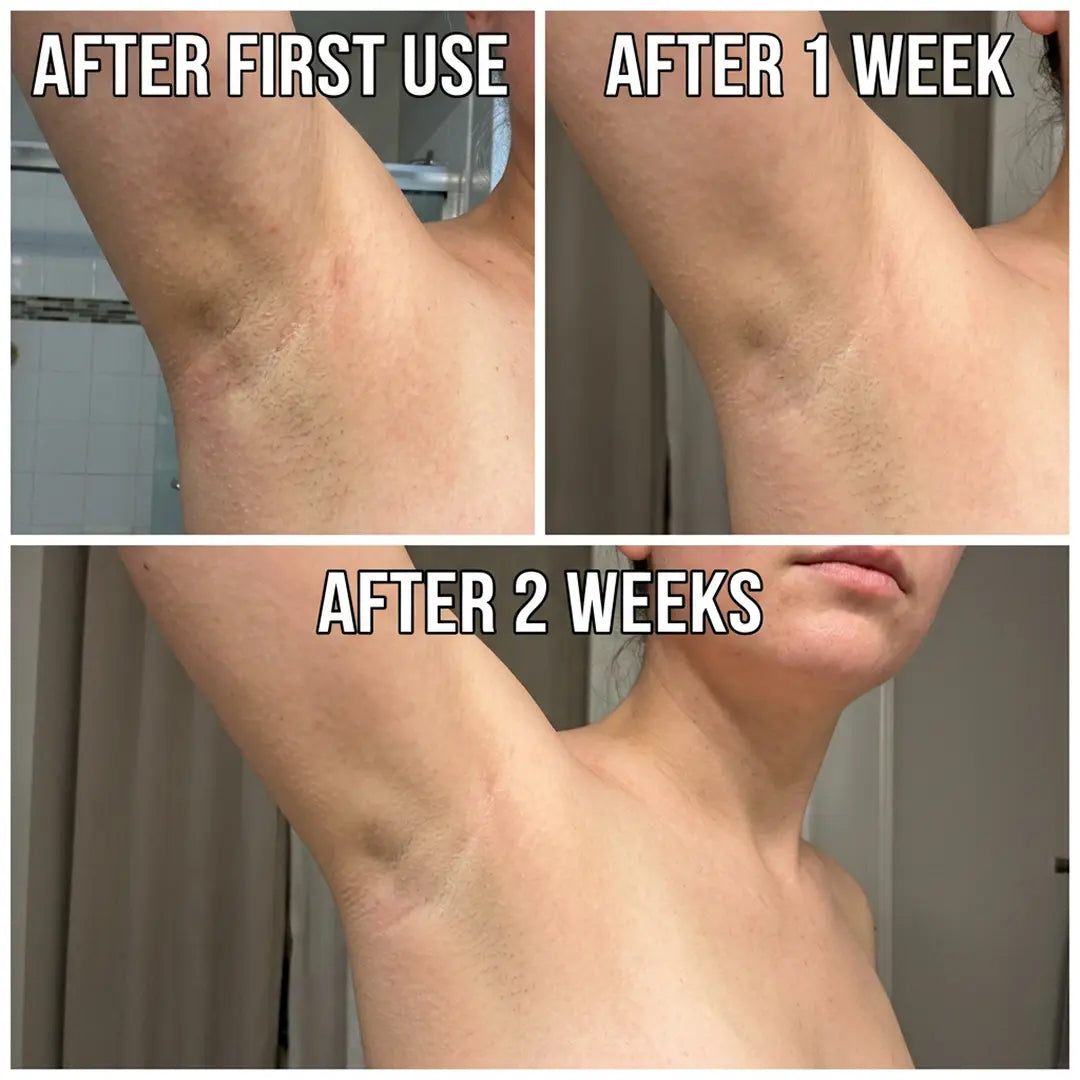
THIS IS WHAT YOUR UNDERARMS LOOK LIKE WITHOUT THE RAZOR

THIS IS WHAT YOUR UNDERARMS LOOK LIKE WITHOUT THE RAZOR

✓ No sharp regrowth tip means no mechanical re-entry. The razor bump cycle stops at the source.

✓ No blade contact means no micro-trauma. Bare Basics removes the primary trigger behind repeated shaving-related darkening.

✓ Smooth skin for up to 2 weeks. You're not managing symptoms every other day—you're changing the method entirely.

30-Day Satisfaction Guarantee: If Bare Basics doesn't change what you've been dealing with, contact customer support within 30 days for a full resolution. No risk.


FREQUENTLY ASKED QUESTIONS

IS IT SAFE FOR THE UNDERARM SPECIFICALLY?

Yes. Bare Basics is formulated for sensitive body areas, including underarms. We recommend a patch test 24 hours before your first full application if you have reactive skin. Most women experience no irritation—and many report less irritation than they had with razors.

IF I STOP SHAVING, WILL THE DARKNESS ACTUALLY STOP GETTING WORSE?

Yes. When you eliminate the mechanical trauma trigger, the chronic inflammation driving post-inflammatory hyperpigmentation stops. Existing pigmentation fades naturally as your skin cells turn over—usually over several weeks. Bare Basics doesn't treat the pigmentation directly. It stops the cycle that caused it.

HOW QUICKLY WILL I SEE RESULTS ON UNDERARM BUMPS AND DARKENING?

Most women notice smoother skin and reduced bumps within the first few uses. Improvements in skin tone develop gradually as the inflammation cycle stops — the timeline varies by individual and cannot be predicted, but many women notice a difference over time with consistent use. Hair removal results last up to 2 weeks per application.

CAN I USE IT IF I HAVE SENSITIVE UNDERARM SKIN?

Yes. The formula includes soothing botanicals like aloe and bisabolol to protect reactive skin during removal. Many women with sensitive underarms find Bare Basics less irritating than shaving because there's no blade scraping the surface. If you have known sensitivities, do a patch test first.

DOES THE SMOOTHNESS ACTUALLY LAST, OR DOES HAIR COME BACK QUICKLY?

Hair grows back softer and slower than it does after shaving. Because the hair is dissolved below the skin surface rather than cut at a sharp angle, regrowth doesn't have the coarse stubble texture you get from a razor. Most women stay smooth for up to 2 weeks per application.

The content on this page is for informational purposes only and does not constitute medical advice. If you have or suspect any medical condition, consult a qualified healthcare professional before using any product. These statements have not been evaluated by the Food and Drug Administration. This product is not intended to diagnose, treat, cure, or prevent any disease or medical condition. Individual results will vary and are not guaranteed. Results described may not represent the typical user experience.