GET 50% OFF WITH CODE SECRET50 - ENDS


IF YOUR BODY HAIR FEELS LIKE SANDPAPER 2 DAYS AFTER SHAVING, YOU'RE NOT IMAGINING IT

★★★★★ 3,896 Reviews | 50,000+ Women

A patient came to my clinic after fifteen years of the same cycle. Her legs felt like sandpaper within two days of every shave. She had tried razors marketed for coarse hair, multi-blade systems, waxing. She had switched products more times than she could count.

The texture never changed and at some point she stopped expecting it to.

What she had been told — by products, by the beauty industry, by her own experience of trying and failing — was that this was simply how her hair grew.

It wasn't.

The problem was what every removal method was leaving behind. The hair type was never the issue.

If that sounds like something you've accepted about your own body, the diagnosis is the same.
You've been using the wrong removal method on hair that deserved a different approach.

✓ Razors marketed for coarse or sensitive hair still cut the shaft at the same oblique angle. A specialized label does not change what the blade does to a coarser shaft.

✓ The sandpaper feeling within forty-eight hours is about what the removal method left at the cut surface — not how fast the hair grows.

✓ The regrowth texture that feels permanent is a removal method outcome. It is not a genetic property.


1. BUYING RAZORS MARKETED FOR "SENSITIVE SKIN"

1. BUYING RAZORS MARKETED FOR "SENSITIVE SKIN"

A razor marketed for sensitive or coarse hair is still a razor. The blade mechanism is identical across every variant—it cuts the hair shaft at an oblique angle, leaving a sharp transverse tip.

The marketing changes the handle, the lubricating strip, and the packaging. It does not change the geometry of the cut.

For women with coarser, thicker hair shafts, that tip is wider. A wider tip creates a harsher tactile sensation as the hair grows back. No label claim or lubricating strip changes this outcome.

Rosie H. VERIFIED BUYER
2. WAXING

2. WAXING

Waxing removes hair by adhering to the shaft and using it as a lever to extract the follicular portion. This applies direct traction to the follicle lining on every pull — not just to the hair itself.

For coarser, more deeply anchored hair, the extraction force required is proportionally greater, and the mechanical stress on the surrounding follicular tissue is more pronounced.

Post-waxing folliculitis, ingrown hairs, and in severe cases permanent scarring are documented complications of repeated waxing in dense, coarse-hair areas.

Rosie H. VERIFIED BUYER
3. THREADING

3. THREADING

Threading is a precision technique — every peer-reviewed clinical study on threading covers facial application only: eyebrows, upper lip, chin. No study has tested or validated it for legs, underarms, or bikini line.

Even where it has been applied to body areas, the shaft geometry is unchanged. The follicle grows the hair back at the same diameter, with the same texture, because threading never altered what the shaft produces on regrowth.

Rosie H. VERIFIED BUYER
4. LASER

4. LASER

Laser requires a melanin contrast between hair and skin to work. For women with darker skin tones — Fitzpatrick types IV through VI — standard systems carry higher documented risks and require specific long-wavelength equipment that many providers don't offer.

The American Academy of Dermatology recommends six to eight sessions minimum, spaced four to eight weeks apart. At $697 per session per ASPS 2025 data, with an average of 8.9 sessions documented in women with skin of color, the full course is a substantial commitment with variable results.

Laser works for women whose skin tone, hair color, and schedule align with what it requires. For women for whom those conditions don't apply, the documented limitations are real.

Rosie H. VERIFIED BUYER
5. ACCEPTING THAT "THIS IS JUST HOW MY HAIR GROWS"

5. ACCEPTING THAT "THIS IS JUST HOW MY HAIR GROWS"

The sandpaper texture within forty-eight hours is not a hair property. Every razor cuts the hair shaft at an oblique angle, leaving a sharp transverse tip.

For women with coarser shafts — diameters measuring 78 to 87 micrometers in several Hispanic, Mediterranean, North African, Arab, and South Asian cohorts — that tip is wider, and it creates more friction as the hair emerges.

The same hair, dissolved chemically rather than cut, produces no tip. Regrowth emerges from a dissolved end — softer, without the abrasive edge the razor created.

Rosie H. VERIFIED BUYER

WHAT YOUR HAIR ACTUALLY NEEDS

WHAT YOUR HAIR ACTUALLY NEEDS

The coarser the hair shaft, the wider the transverse tip a razor leaves behind. The regrowth experience is most pronounced for women whose shaft diameter is largest.

Bare Basics No-Shave Hair Removal Cream removes hair chemically rather than mechanically. Calcium thioglycolate breaks the disulfide bonds in the hair shaft below the skin's surface, dissolving the hair without blade contact. Regrowth emerges without the sharp transverse tip that produces the sandpaper sensation and drives follicular re-entry.

For women whose hair type makes razor regrowth particularly harsh, removing the razor removes the geometric source of the problem entirely.

HOW THE FORMULA ADDRESSES WHAT RAZORS CAUSE

Calcium Thioglycolate (5%)
Dissolves hair at the disulfide bond level below the skin surface—no oblique cut, no sharp transverse tip, no abrasive regrowth edge regardless of hair shaft diameter.

Aloe Barbadensis Leaf Juice (1.2%)
Soothes the skin surface during chemical removal, counteracting the surface irritation that compounds with repeated mechanical extraction methods.

Bisabolol (0.1%)
Reduces follicle-level inflammation from repeated mechanical trauma—addressing the deeper irritation that accumulates when extraction-based methods are used on densely anchored hair.

Tocopheryl Acetate (0.1%)
Conditions and protects the skin barrier post-removal, countering oxidative stress and moisture loss that accumulates after repeated removal attempts across body areas.

Dipotassium Glycyrrhizate (0.05%)
Calms chronic low-grade follicular inflammation—the background reactivity that makes alternative removal methods harder to tolerate in women with dense, coarse hair.

Allantoin (0.15%)
Promotes skin cell renewal and surface recovery after the mechanical and chemical stress cycles that repeated failed removal attempts create.

30-Day Satisfaction Guarantee


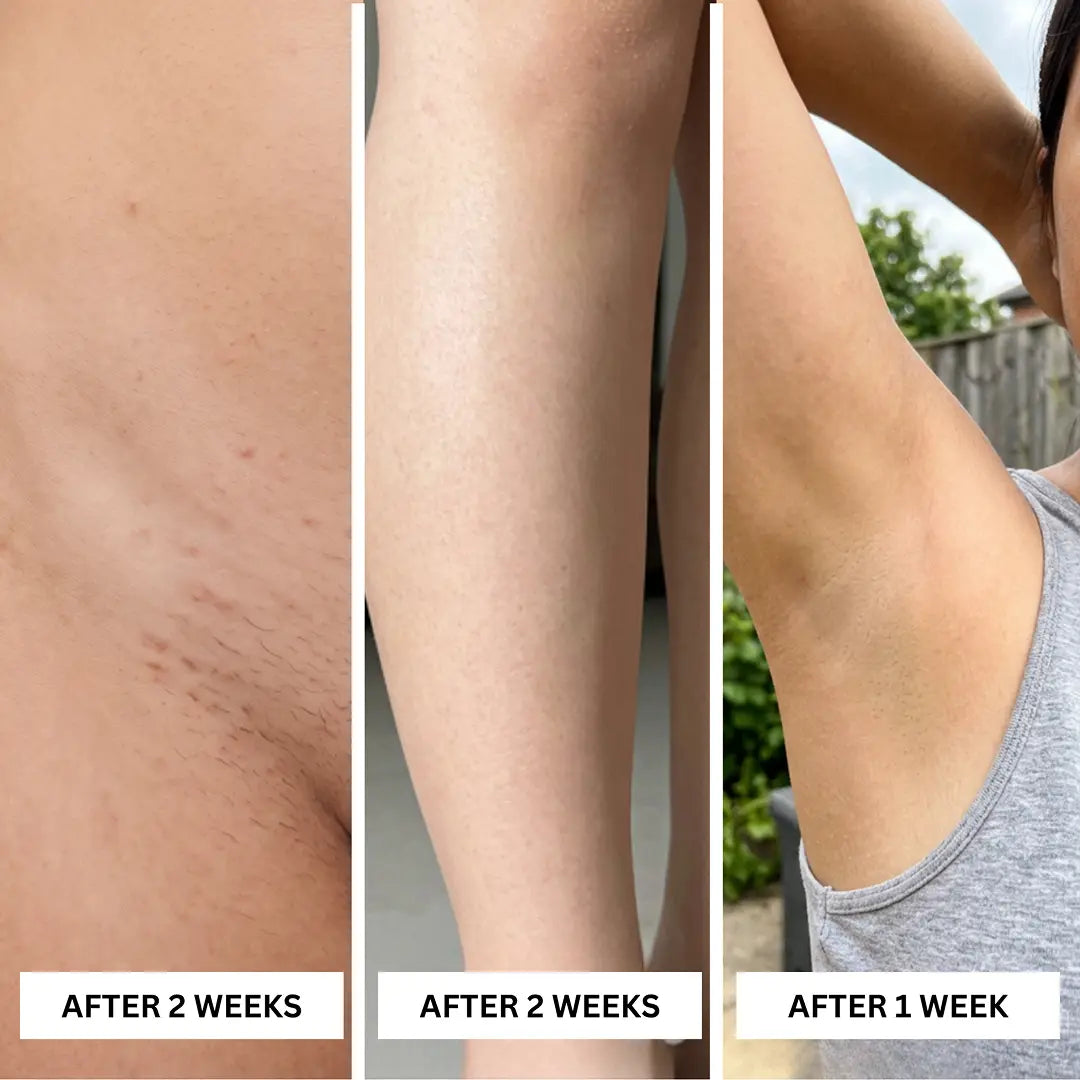
THIS IS WHAT COARSE HAIR LOOKS LIKE WITHOUT THE RAZOR

THIS IS WHAT COARSE HAIR LOOKS LIKE WITHOUT THE RAZOR

✓ No sharp transverse tip in regrowth → no mechanical friction against skin surface → the sandpaper cycle stops at the source.

✓ No blade contact → no mechanical trauma → removes the primary driver of razor-related irritation and follicular inflammation in coarse-hair skin.

✓ Smooth skin for up to 2 weeks per application—compared to the 48-hour cycle most women with coarse hair have accepted as normal. The method determines the duration, not the hair type.

30-Day Satisfaction Guarantee. If Bare Basics doesn't change what you've been dealing with, contact customer support within 30 days for a full resolution. No risk.


FREQUENTLY ASKED QUESTIONS

IS IT SAFE FOR ALL BODY AREAS INCLUDING COARSE HAIR ZONES?

Yes. Formulated for legs, underarms, and bikini line. The active ingredient dissolves hair without blade contact. Patch test 24 hours before first use is recommended.

WILL THE REGROWTH ACTUALLY FEEL SOFTER, OR WILL IT GO BACK TO FEELING THE SAME?

The softer regrowth is a result of how the hair is removed—not a treatment of the hair itself. As long as Bare Basics is used instead of a razor for each removal session, the sharp transverse tip is not produced. Regrowth texture reflects the removal method used most recently.

HOW DOES THIS COMPARE TO LASER FOR WOMEN WITH COARSE, DARK BODY HAIR?

Laser works for many women but has documented compatibility requirements—skin tone, hair color, session availability. Bare Basics works regardless of Fitzpatrick skin type, requires no sessions, and costs significantly less per application. Different mechanisms: laser targets the follicle; Bare Basics dissolves the shaft chemically at each application.

HOW QUICKLY WILL I SEE A DIFFERENCE IF MY HAIR GROWS BACK FAST?

Hair removal occurs within the application window (5–7 minutes). Smooth skin lasts up to 2 weeks per application depending on individual hair growth cycle. The change in regrowth texture—softer, without the sharp edge—is noticeable from the first use.

CAN I USE IT ON MULTIPLE BODY AREAS IN THE SAME SESSION?

Yes. Formulated for use on legs, underarms, and bikini line. Apply, leave on 5–7 minutes, remove with lukewarm water. Do not apply to the face or sensitive intimate areas. Patch test before first use always recommended.